
What Would a Living Café Menu Look Like?
A supplier raises a price. What should change on the menu, and how would you know?
Sasha, co-founder of Chefo ·
A friend recently told me that one of her suppliers had raised their prices. Her menu was already set.
She now had to work out what that meant for the dishes she served, how much of the increase she could absorb, and whether anything needed to change.
I kept thinking about that conversation. You put so much work into a menu: developing recipes, choosing ingredients, finding suppliers, training your team. You find a balance between what you want to make, what your customers enjoy, and what makes sense for the business. Then something changes, and you have to work through that balance again.
How easy is it to understand what actually needs your attention?
I’m a product designer and co-founder of Chefo. This is one of the questions shaping how we think about the future of menus for cafés and restaurants.
A supplier’s price increase is a useful example because it sounds straightforward. An ingredient becomes more expensive, so perhaps you raise the price of the dish. But there are several decisions to make before you get there.
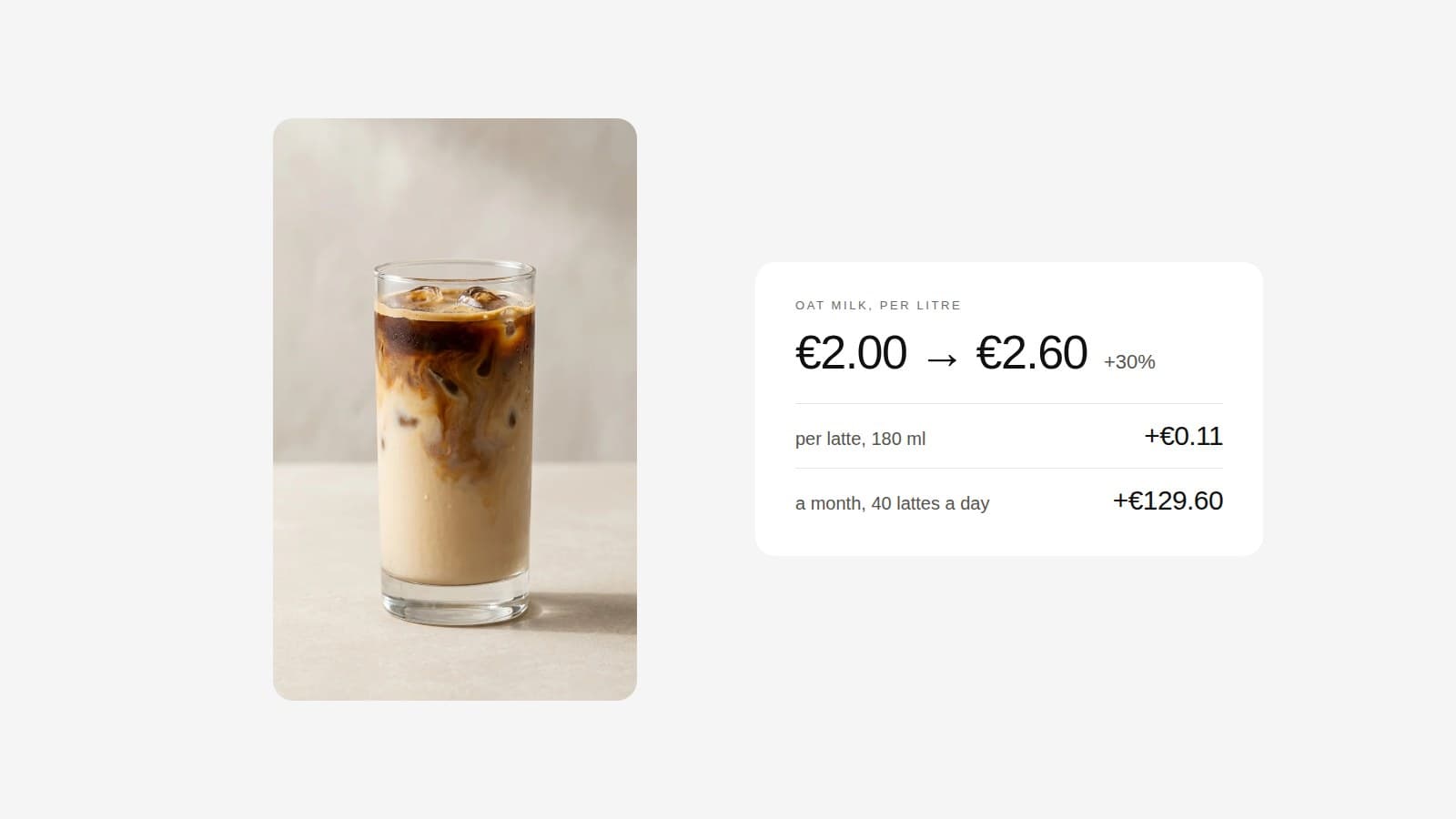
Take a simple hypothetical example. Suppose the oat milk you buy rises from €2.00 to €2.60 per litre, a 30% increase. If each latte uses 180 ml, the milk costs €0.108 more per drink, or just under 11 cents. At 40 oat lattes a day over 30 trading days, that adds €129.60 to your monthly ingredient costs, before allowing for any extra milk used or wasted during preparation.
Would that be something you could comfortably absorb, or would it change whether the drink still works financially?
You might decide to keep the price because it matters to your regular customers. That can be a reasonable choice. I would just want the owner to understand what that choice costs and when it might be worth revisiting.
Keeping the menu unchanged doesn’t make the extra cost disappear.
There can be very little room to absorb these changes. A 2025 National Restaurant Association report, based on data from more than 900 US restaurants, reported median income before taxes of 2.8% of sales for full-service restaurants and 4.0% for limited-service restaurants. Those figures describe a particular market and sample, but they give some context for why changes in everyday costs deserve attention.
What feels difficult to me is how much work an owner may have to do to connect all of this.
The new price arrives in a supplier’s message. The recipe is somewhere else. Sales tell you how popular the item is. Your team knows whether preparing it creates problems during service. Each piece tells you something, but you still have to bring them together before you can make a decision.
And costs are only one part of the picture.
Perhaps a seasonal ingredient becomes available. Perhaps something you expected to sell well keeps being left over. A drink might be popular but take too long to prepare when the café is busy. A local event could create an opportunity for a special, provided your team can manage it.
These signals matter because they can change what makes sense for your particular café. Their relevance depends on your menu, your customers, your team, and what you are trying to achieve.
That is where I think a more adaptable menu could help.
I understand the hesitation around that idea. As a customer, I also want to return to a place and find the thing I loved last time. I wouldn’t enjoy discovering that my usual order had become smaller or tasted different because someone had quietly adjusted the recipe.
So, for me, adaptability starts with understanding what should stay consistent.
Your signature dish might stay exactly as it is. You could reconsider the seasonal dishes around it, prepare smaller batches of something that regularly goes unsold, or change how you purchase an ingredient without changing its quality.
Sometimes the signature dish itself becomes more expensive to make. Then there is a real choice to work through. You could adjust its price, explore another supplier, or accept a lower margin for a while. Each option has consequences. A different supplier needs testing. A price increase may affect demand. Absorbing the cost leaves less money available elsewhere.
There may also be opportunities elsewhere in the menu. A pairing or an optional addition could be worth exploring if customers actually want it and the extra work makes sense for the team. It needs to be considered in the context of the whole business.
I don’t think there is one correct answer that software should give every owner.
What I would like to make easier is understanding the situation early enough to have a choice. To see which items are affected, how much it matters, and what could realistically change. Then the owner can decide what they want to protect and where they are comfortable experimenting.
Perhaps we have become used to reviewing menus at particular moments because updating everything takes so much effort. I wonder what would happen if the work between those reviews became easier.
The customer could still experience a familiar café, with the same care and character. Behind it, the owner would have a clearer understanding of what was changing and more room to respond thoughtfully.
That is the direction we’re exploring with Chefo.
If you run a café or restaurant, I’d love to hear about a recent change that made you reconsider part of your menu. What happened, and what would have helped you make the decision?
Today, Chefo calculates ingredient costs per drink from your recipes and ingredient prices, helping you review costs as those prices change. Explore Chefo.